Guide to Liverworts of Oregon: Anthelia julacea (L.) Dum.
HOME SPECIES INDEX GENUS INDEX GLOSSARY
1a plants leafy > 3b leaves not divided, not ciliate > 6b oil bodies absent 13b oil bodies absent > 16b underleaves large > 18b underleaves bilobed > 19a leaves tightly overlapping > Anthelia 1b dioicous; elaters broad
1a plants leafy > 3b leaves not divided, not ciliate > 6a oil bodies 2+ or unknown 7b no small dorsal lobe > 10a succubous or transverse > 11b isophyllous > 25a bilobed more than 0.5 > 26b leaves less than 0.5 mm > Anthelia 1b dioicous; elaters broad
Synonym:
Special status: None, pending verified Oregon record.
Recognition: Small (<1 mm dia.) julaceous plants with three rows of tightly appressed, deeply bilobed leaves. Lobe tips sharp. Very soft and fragile under the forceps (leaves are hard to detach intact). No oil bodies. Covered with a white, filamentous coating giving silvery appearance in the field. The two, wide, strap-like spirals of the elaters and dioecious condition separate this from A. juratzkana. (but see Mizutani, M. 1967. Misc. Bryol. Lichen. 4:79. (need translation; on variability in Japanese Anthelia) for possible problems)
Distribution: On peaty soil, often with sparse shrub cover. My collection from the north side Mt. Hood (DHW 2366a), on the Multnomah-Hood River County Line was previously cited as the basis of positive occurrence in Oregon but a re-examination of that collecion in 2016 resulted in determining it is actually A. juratzkana. Also reported from Clackamas and Wallowa Counties by ORNHIC.
Comments: Genus easily recognized, but need fertile material with capsules for positive species identification. Crenulation of leaf margins may provide a clue but needs study with regional material to determine reliability. Smith (1990) says, "There is a considerable body of opinion that A. julacea and A. juratzkana are not distinct species, but they differ markedly in reproductive structures and there seem no grounds for reducing A. juratzkana to a variety of A. julacea. The former is readily recognized in the field by the clavate fertile shoots and the non- or scarcely exserted perianth." Also reported from California without specimen citation (Schuster 1974).
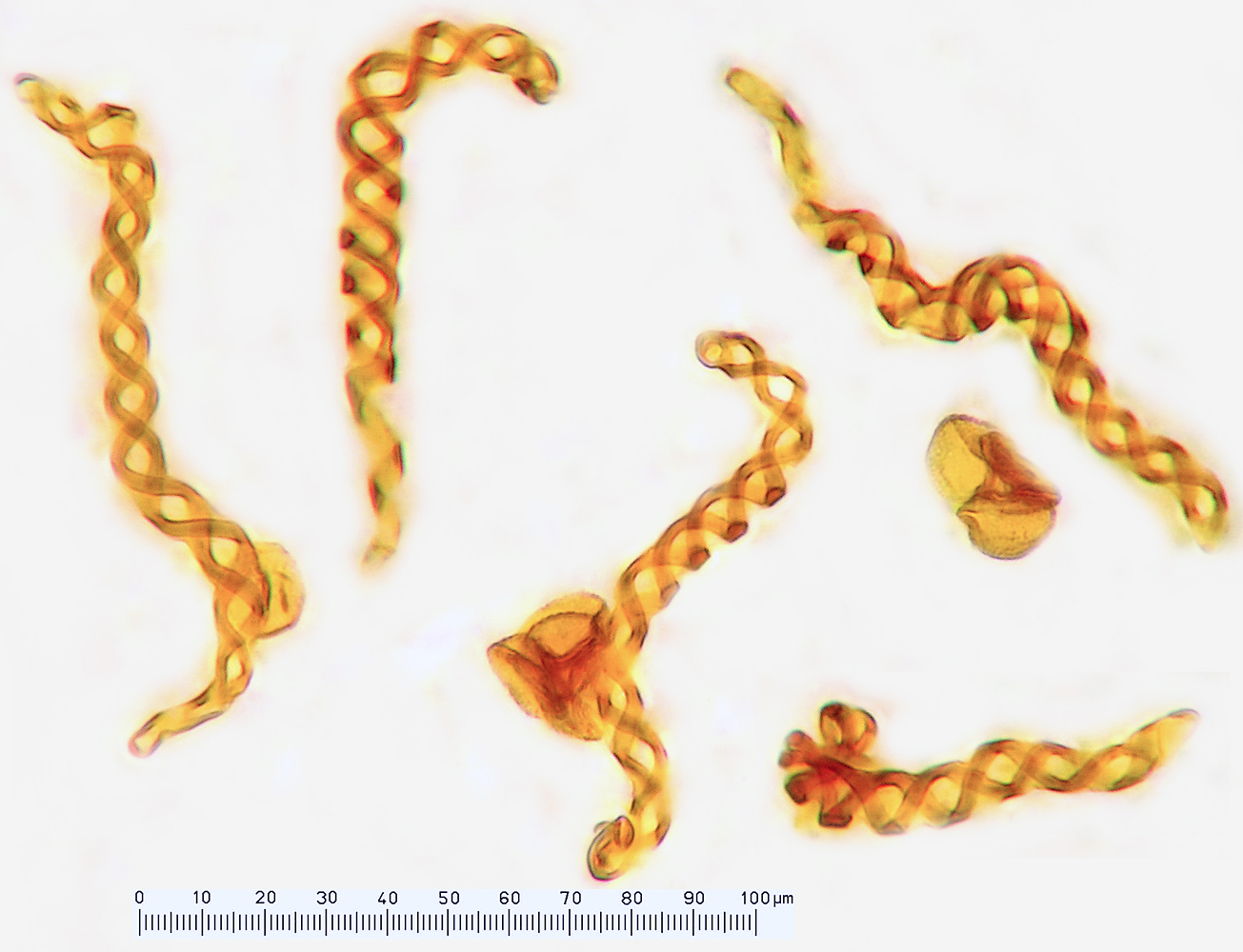 McNeil Point, Mt. Hood, Multnomah Co., Oregon. DHW 2366a (5 Sept 1979).