Guide to Liverworts of Oregon: Porella bolanderi (Aust.) Pears.
HOME SPECIES INDEX GENUS INDEX GLOSSARY
1b plants not peppery tasting > 2a underleaves strongly toothed > 3a ventral lobes decurrent > Porella bolanderi
Synonym: NONE
Special Status: ORBIC List 2.
Recognition: With large lobules and underleaves of approximately the same size, the genus is easily recognized with a hand lens. The closest look alike is P. cordaeana, from which it can be distinguished in most cases by the densely imbricate underleaves. Porella bolanderi tends to have darker leaves than P. cordaeana, packed so close together they are curled around each other. However, P. cordaeana sometimes has densely spaced leaves. These can only be separated from P. bolanderi with absolute confidence using the an iodine test. Lack of a peppery taste separates it from P. roellii and plane underleaf and lobule margines separates it from P. navicularis.
Distribution: On bark of hardwood trees; found mainly in southwestern Oregon and reaching as far north as Lane County.
Comments: There are numerous past literature reports of this from north of Lane County, Oregon, all of which are doubtful. The species was widely misunderstood, the main source of confusion being the dense leaved forms of P. cordaeana mentioned above.
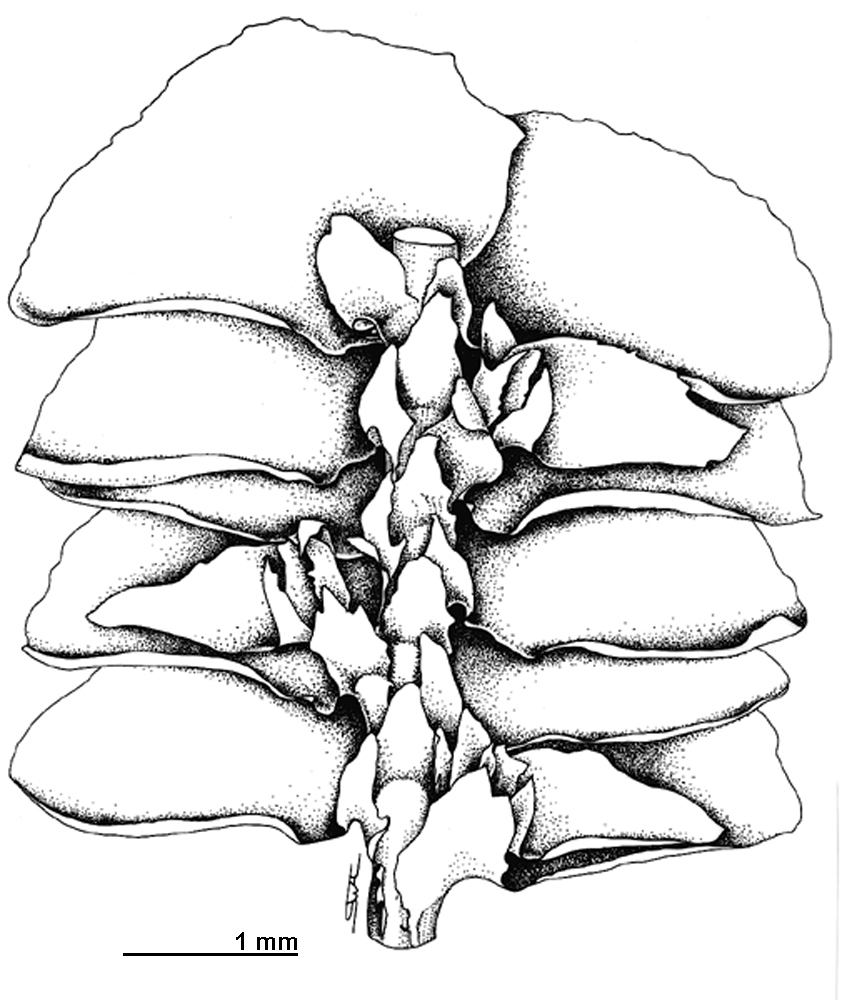 Porella bolanderi. Drawing by S. Allison.
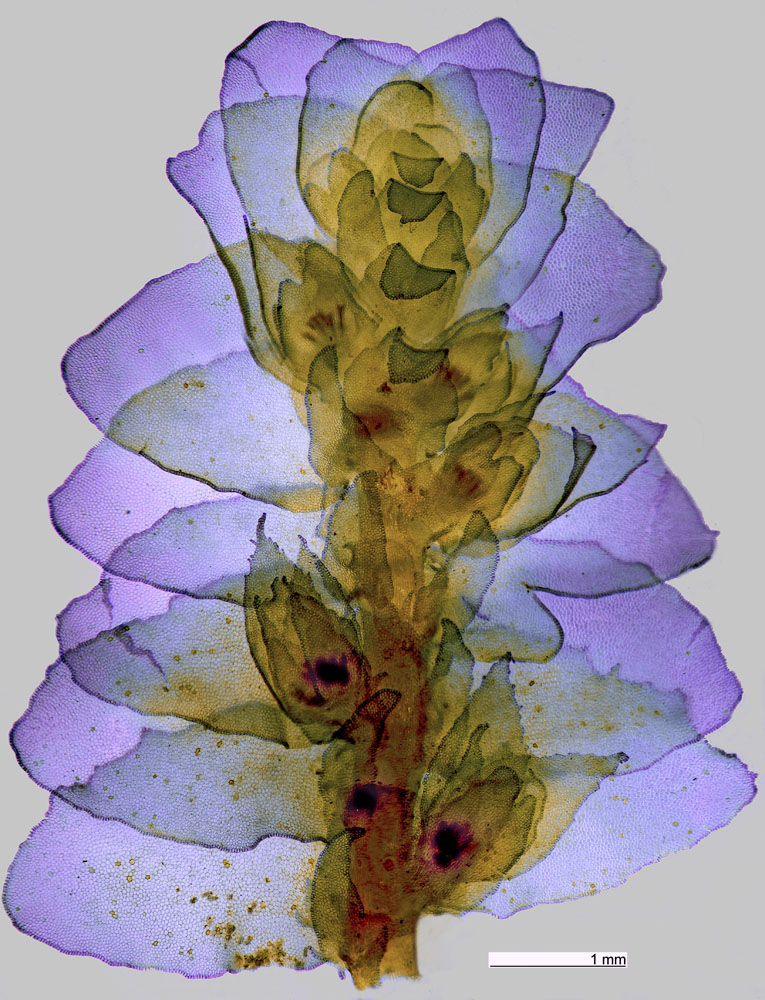 Porella bolanderi. Female shoot. Pickett Creek, Josephine County, Oregon. D. Stone 4155.