Racomitrium ericoides (Web. ex Brid.) Brid.
HOME INDEX TO SPECIES BACK TO KEY
Synonym: Niphotrichum ericoides (Web. ex Brid.) Bednarek-Ochyra & Ochyra
Special status: NONE
Recognition: The long, white hair points and prominent papillae on the leaf cells are unmistakable features of the subgenus Niphotrichum, giving them an appearance that one can learn to recognize at a distance. Racomitrium canescens is separated on the basis of its costa being relatively distinctive compared to R. elongatum and N. ericoides. Both R. elongatum and N. ericoides have a slender costa that terminates just below the hair point, the costa sitting in a narrow channel. Racomitrium canescens, on the other hand, has a shortish, irregular costa, often slightly branched, that terminates in a broad trough at the leaf apex.
Separating R. ericoides from R. elongatum is difficult. As mentioned under R. elongatum, one needs to gauge the less bumpy hair points and longer pellucid border on basal leaf margins of the more rare R. ericoides.
Distribution: Apparently quite rare in Oregon; I have never seen it. Not Frisvoll (1983), nor Bednarek-Ochyra (1995), nor Ochyra and Bednarek-Ochyra (2007) give specific localities for Oregon although it is shown as occurring in Oregon on their distribution maps. The Flora of North America shows a dot for California also (Ochyra and Bednarek-Ochyra 2007).
Comments: This species is reported from California by Norris and Shevock (2004a) but it is not clear whether this species or Racomitrium canescens is being referred to because the two were mixed up in the keys (Norris and Shevock 2004b). An authentic specimen of R. canescens would key to R. ericoides and a specimen of the latter would key to R. elongatum. Racomitrium canescens in the strict sense is missing from their keys and catalog.
Since the time this key was written, a specimen of Racomitrium pygmaeum Frisvoll has been reported from Oregon by Ochyra (2015). It was previously known only from British Columbia and Washington, and remains a very rare and restricted species. I have not seen a specimen nor any illustrations other than those in the original description (Frisvoll 1983). There is a good description in Flora of North America, vol. 27 (Ochyra & H. Bednarek-Ochyra 2007) where it is treated as Niphotrichum pygmaeum (Frisvoll) Bedn.-Ochyra & Ochyra. Important characters are small size (leaves less than 1.7 mm) with opaque, densely papillose median and distal leaf cells.
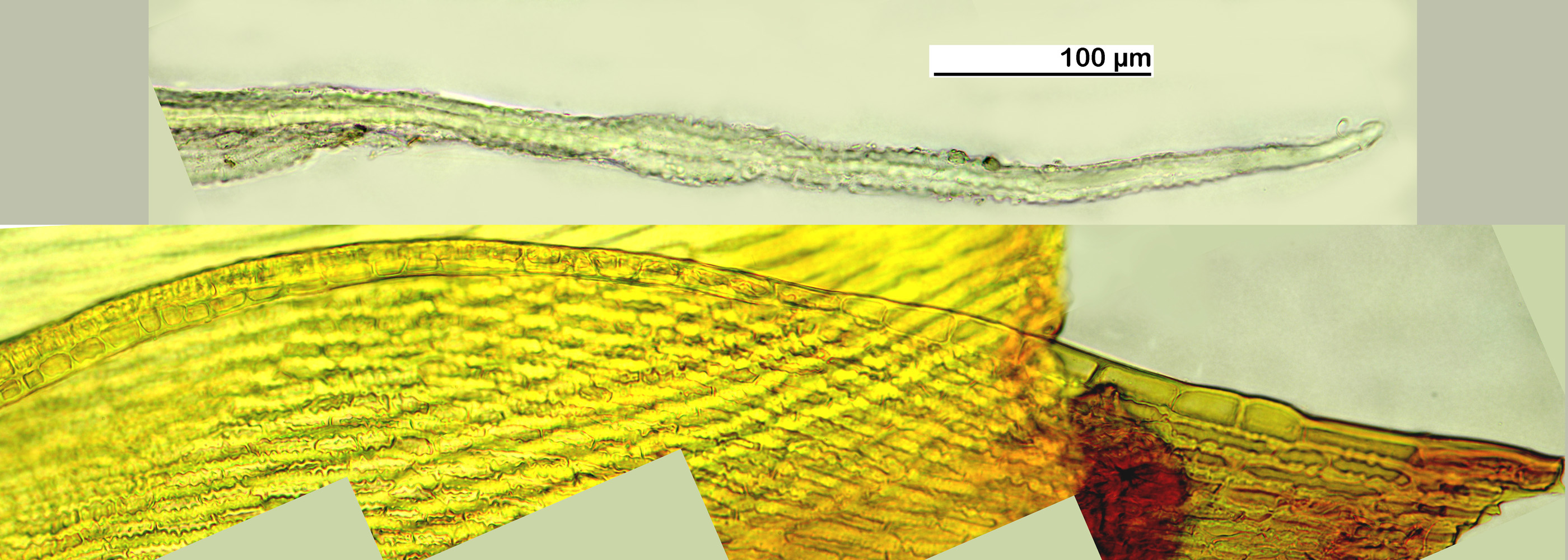 Racomitrium ericoides; Snohomish Co., Washington. Lesher
4488c
Racomitrium ericoides; Snohomish Co., Washington. Lesher
4488c
HOME INDEX TO SPECIES BACK TO KEY