Guide to Liverworts of Oregon: Key to Jungermannia 1
HOME SPECIES INDEX GENUS INDEX GLOSSARY
1b plants leafy > 3b leaves not divided, not ciliate > 6a oil bodies 2+ or unknown > 7b no small dorsal lobe > 10a succubous > 11a anisophyllous > 12a leaves entire > 28a underleaves inconspicuous > 29b if rhizoids red, stems red > 30b leaf plane or evenly curved > 31a trigones bulging, bracteoles absent > Jungermannia
IMPORTANT TAXONOMIC NOTE: The key here is grounded on Jungermannia in the traditional sense. Synonyms are provided for each species for further search in current literature. Much work with DNA phylogeny in the past decade has resulted in various changes suggested for classification, including placing some species of traditional Jungermannia into separate families. Stotler & Crandall-Stotler's Synopsis (2017) is a good place to start. As much as possible, the nomenclature of individual species follows the preferred name listed in their Synopsis
Jungermannia in the traditional sense has always been hard to work with because it is the most generalized of the leafy liverworts. The diagnostic characters field are round, succubous leaves on a shoot lacking underleaves. Absence of underleaves is always tougher to establish with confidence than presence. It is hard enough just to be sure one is in the right genus, even harder is to determine species, unless mature, fertile material is available.
The following keys depend on having mature perianths at hand, or at least being able to tell if a plant is monoicous or dioicous. The number, size, and form of oil bodies in living cells are important data to note. Eventually, with focused attention in a restricted region, it is possible to gain an intuitive sense of the vegetative characteristics of the common species so that field identifications can be made with a reasonable level of confidence.
Because many of the species rarely produce gametangia, fresh material may be identified reasonably well by becoming familiar with all the illustrations of likely species. For example, Solenostoma fusiforme has never been found with perianths in North America but it is such a distinctive species that matching a fresh specimen with its photos is easy. The sterile specimen key in Doyle and Stotler (2006) is the best currently available because it covers all California species of Jungermannia in the traditional sense. Identification of sterile, dried material beyond a best guess may be futile even with laboratory examination of microscope slide preparations.
Solenostoma rubrum is one of our most common terrestrial liverworts west of the Cascades. Jungermannia atrovirens is a common aquatic/rheophyte at lower elevations while Jungermannia exsertifolia is a frequent aquatic at higher (subalpine) elevations.
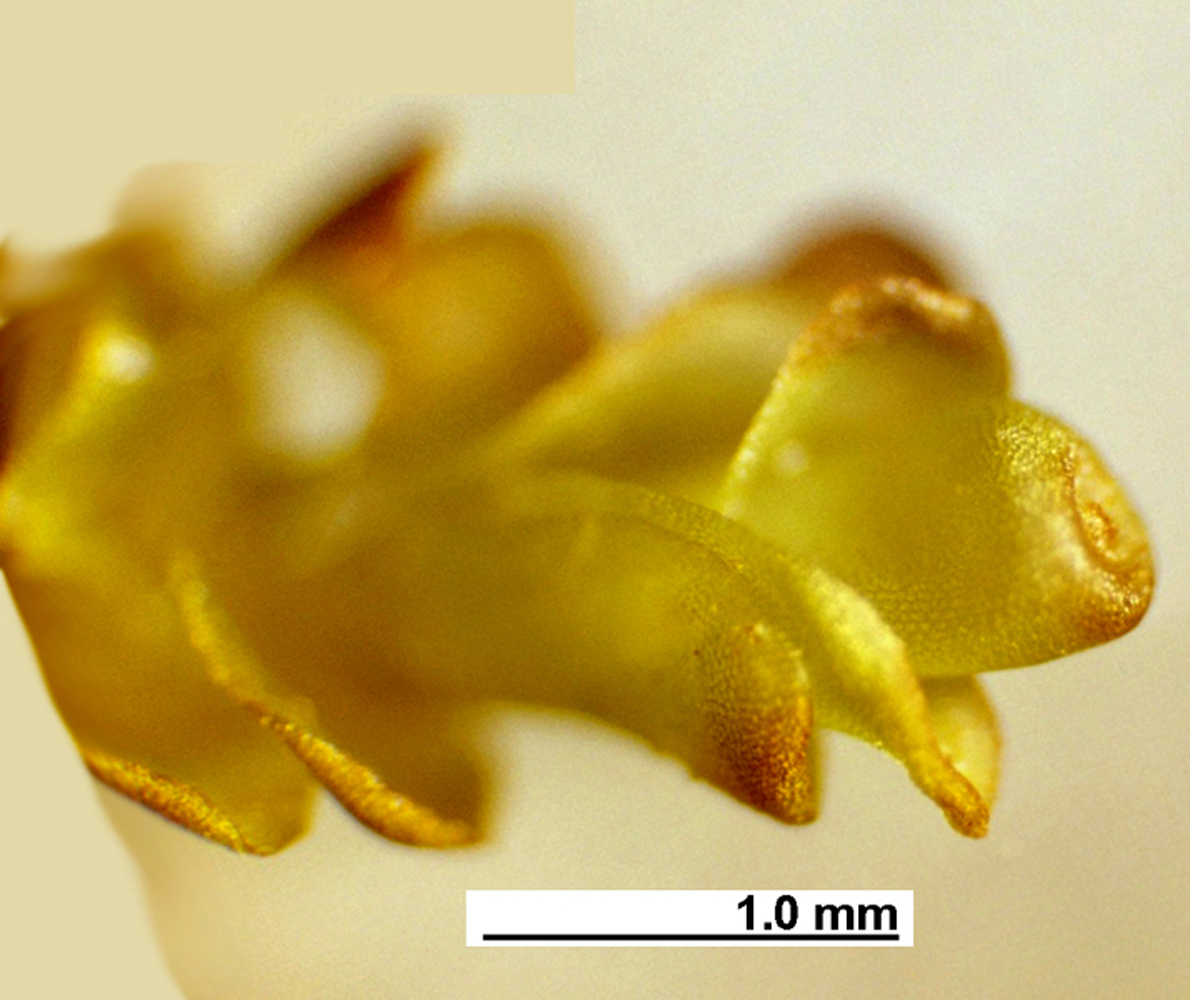 Liochlaena lanceolata> - Pine Creek, Modoc County, California, DHW m1443.
1a Perianth exserted well beyond bracts; perigynium short; perianth beaked in some species; rhizoids colorless or brownish; some species aquatic
(Couplet 2)
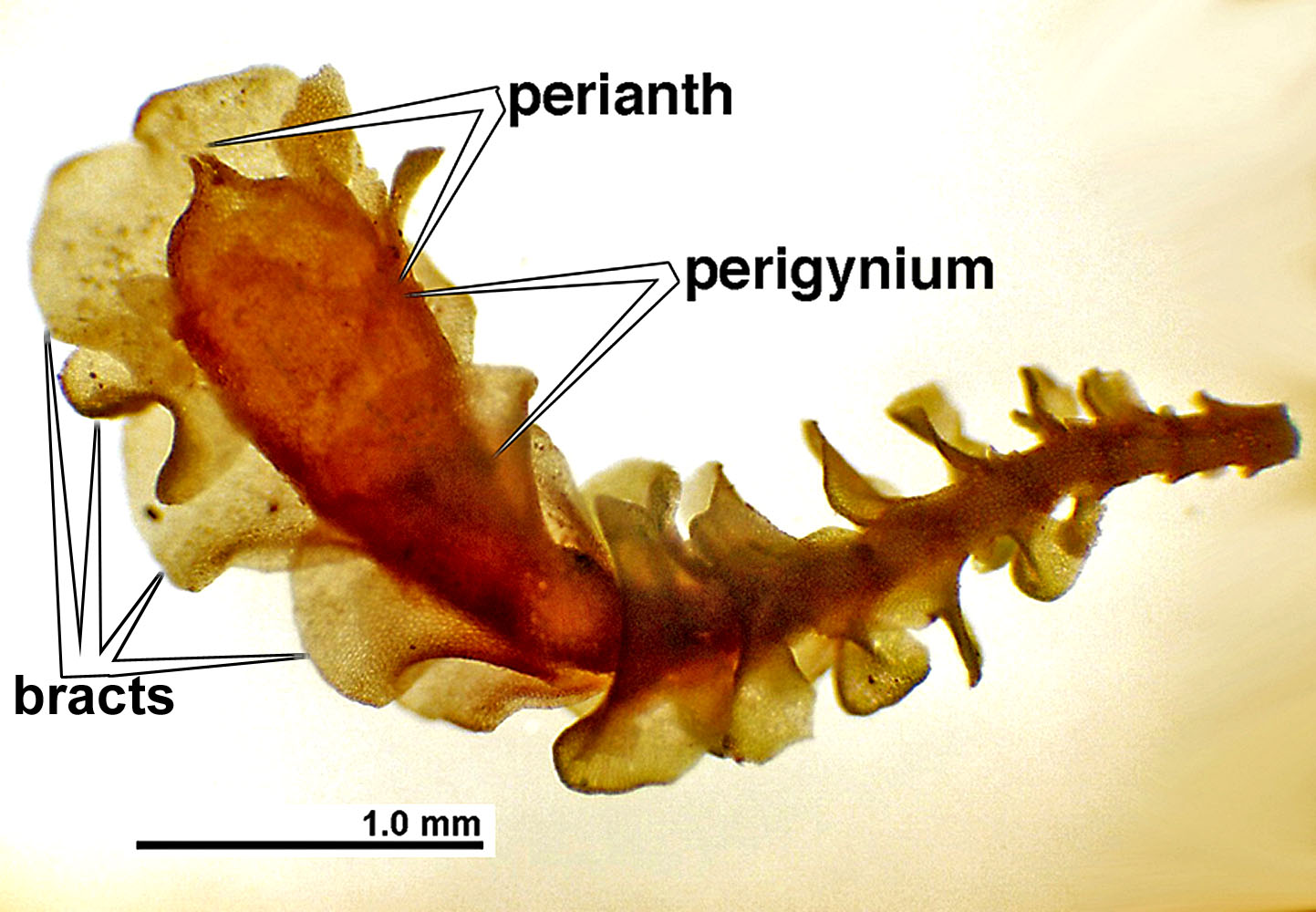
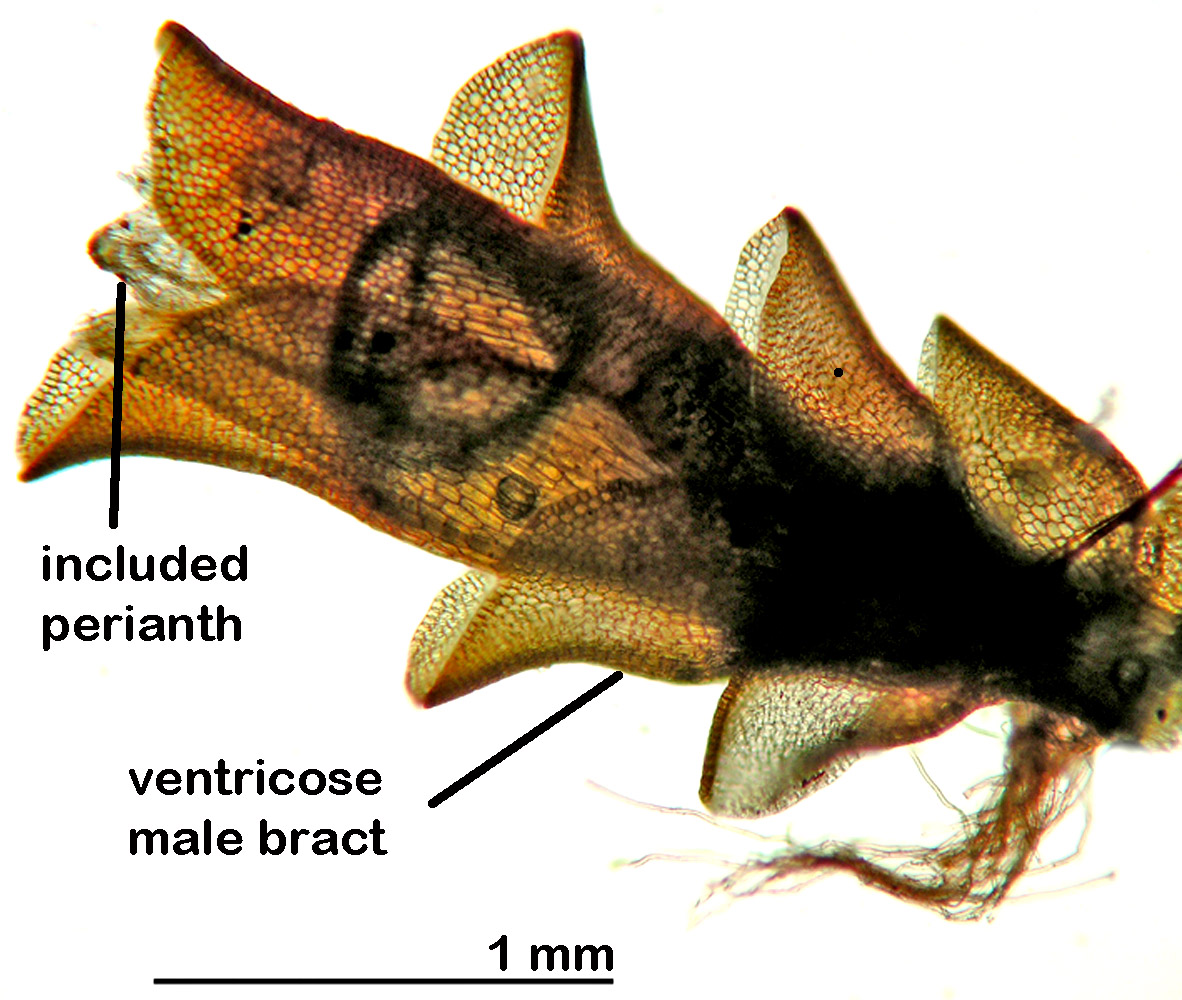 Jungermannia obovata - Darrington District, Washington. USFS 8899E.
1b Perianth shorter than or just barely longer than the bracts, fused to the bracts for ca. 0.5 its length (perigynium > or = free perianth); perianth not beaked; rhizoids purplish or reddish; never aquatic. (Solenostoma subgenus Plectocolea; Plectocolea in the strict sense [Bakalin 2016]).
(Couplet 7)