Guide to Liverworts of Oregon: Key to Lophozia 1
HOME SPECIES INDEX GENUS INDEX GLOSSARY
1b plants leafy > 3b leaves not divided, not ciliate > 6a oil bodies 2+ or unknown > 7b no small dorsal lobe > 10a succubous > 11a anisophyllous > 12b leaves lobed > 37b if rhizoids red, stems red > 38a shoots wider than 1 mm > 39b underleaves inconspicuous > 55b leaves succubous > 58b shoots >1.2 mm wide > 59b lobes acute or oil bodies >12 > 60b terrestrial > 61a oil bodies present in all cells > Lophozia 2
Lophozia, as circumscribed for much of the previous century, has had the reputation of being one of the largest and most difficult genera of liverworts. Since this genus treatment was started (2006) there has been a torrent of studies aimed at sorting out the included species into smaller, more natural groups. Many of these segregates were given separate genus names. The key here was written to deal with Lophozia in the broad sense, with the subgroups given the nomenclature appropriate to current taxonomy based on modern phylogenetics as much as possible. The major sources for current taxonomy have been the Synopsis of North American Liverworts, by Stotler & Crandall-Stotler (2017), provisional treatments for the liverwort volume of Flora of North America, and the website Tropicos maintained by the Missouri Botanical Garden.
Some species are quite common, some I have seen rarely, some I have seen only as dried herbarium specimens. Some I have not seen at all, not even in the herbarium, and are included here based on literature reports. As a consequence, portions of the key are based more on published descriptions, primarily Schuster's works, than on direct experience. Differentiation of species in this genus is necessarily based on technical characters; sterile material may be quite indeterminable, likewise dried material lacking oil bodies. Identification of the other species keyed here should always be verified by comparison with authentic material, further study in technical manuals, and/or examination by an expert. Note that all species presently reported from the Pacific Northwest are treated in Schuster (1969), i.e., all are known from eastern North America, also. There are, however, some unidentified collections of Lophozia from our area which are either undescribed endemics or unrecognized disjuncts from other continents. Check rhizoids before using this key: if rhizoids are purplish-red on a green stem, see Fossombronia; all Lophozia with red rhizoids also have red stems.
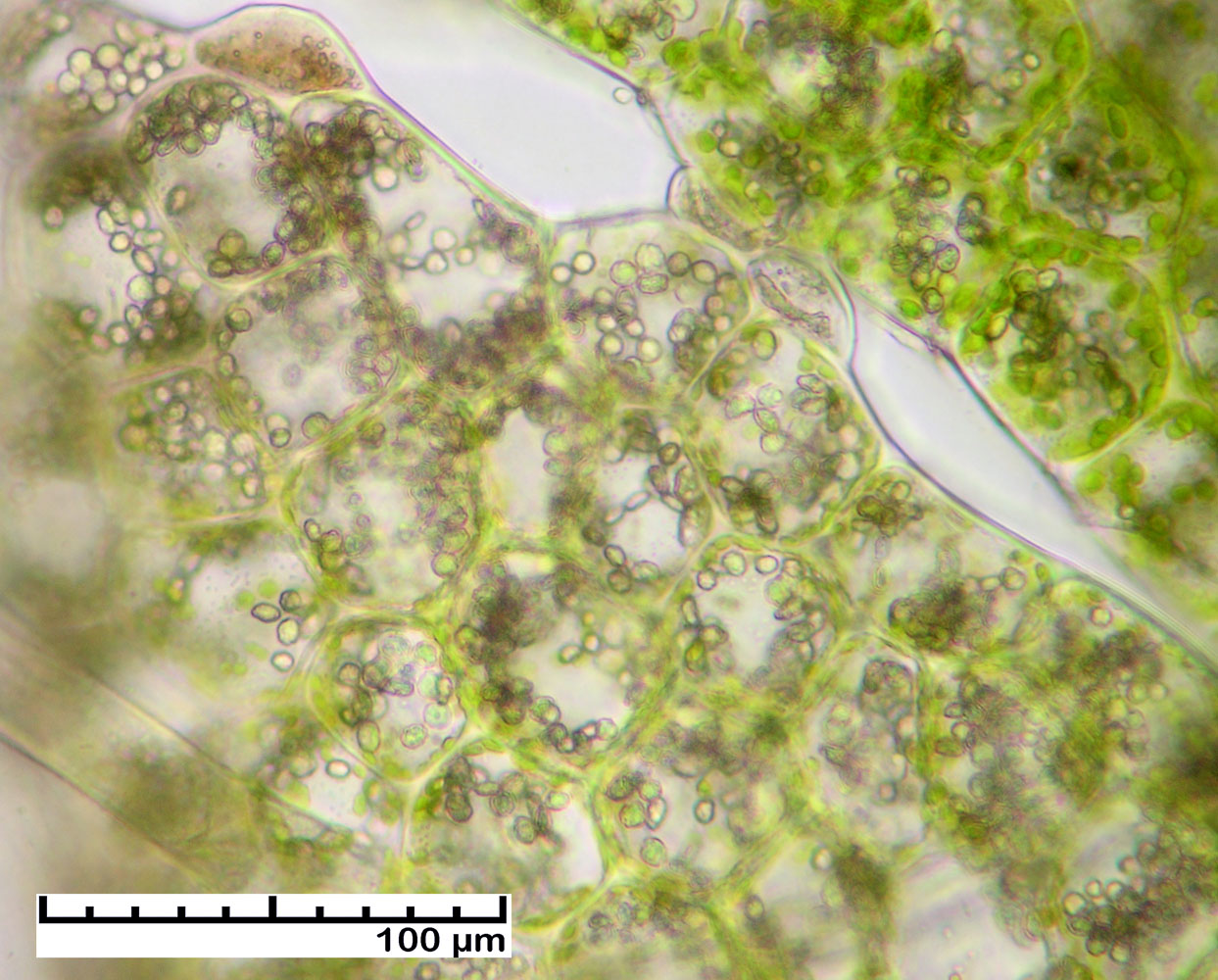 Lophozia incisa - Butte Creek Falls, Linn Co., Oregon. DHW m1850.
1a Oil bodies homogeneous, numerous, 15-50 per cell, minute, (smaller than the chloroplasts); leaves mostly 3-lobed, occasionally bilobed (Subgen. Massula)
(Couplet 2)
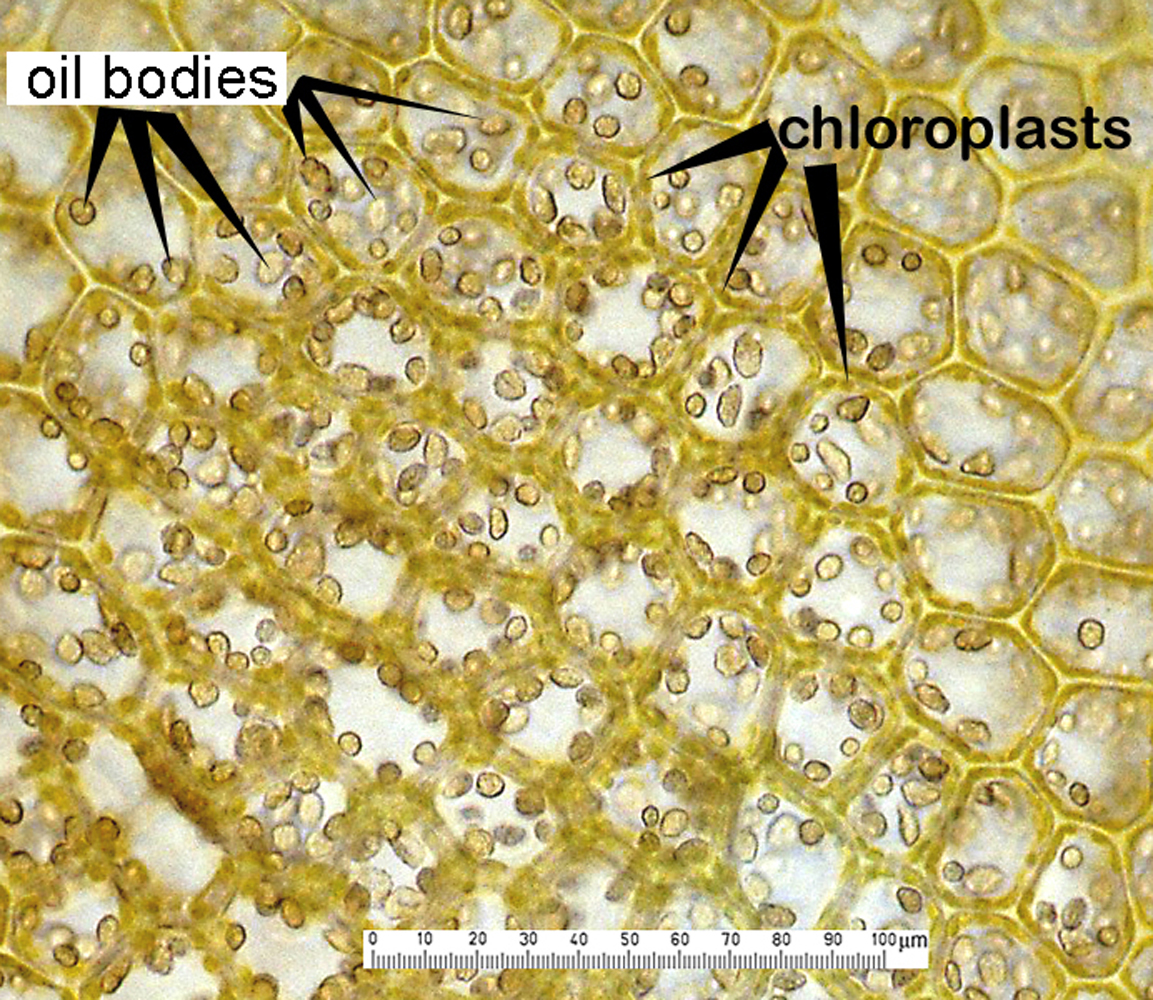 Lophozia hatcheri Cells with oil bodies. Fish Hook Peak, Curry Co., Oregon. DHW
m1673
Lophozia hatcheri Cells with oil bodies. Fish Hook Peak, Curry Co., Oregon. DHW
m1673
1b Oil bodies faintly to minutely granulose, mostly averaging fewer than 12 per cell, and larger than the chloroplasts, if average is more than 12, then distinctly granulose; leaves bilobed or 3-4 lobed
(Couplet 5)