Guide to Liverworts of Oregon: Key to Marsupella 1
HOME SPECIES INDEX GENUS INDEX GLOSSARY
1b plants leafy > 3b leaves not divided, not ciliate > 6a oil bodies 2+ or unknown > 7bno small dorsal lobe > 10a succubous > 11a anisophyllous > 12b leaves lobed > 37b if rhizoids red, stems red > 38b shoots mostly <0.5 mm wide > 47b underleaves inconspicuous > 50a shoots julaceous > 51b dark green to black > Marsupella
1b plants leafy > 3b leaves not divided, not ciliate > 6a oil bodies 2+ or unknown > 7b no small dorsal lobe > 10a succubous > 11a anisophyllous > 12b leaves lobed > 37b if rhizoids red, stems red > 38a shoots wider than 1 mm > 39b underleaves inconspicuous > 55a leaves transverse > 56b leaf lobes equal > 57b trigones present > Marsupella
This genus is difficult to work with because of the small size of most of the included species. The following key is adapted from Hong (1982). It is not easy to use because of its reliance on sexuality in the first couplet, meaning one must find fertile plants and dissect out the sex organs. The size differences are not always as sharp as the key suggests.
Perianths are poorly developed, or not produced at all, in Marsupella. Fertile shoots are marked by a swollen, clavate tip. If a species is paroicous, there will be archegonia at the tip of the stem, nestled between female bracts that appear to be simply enlarged leaves, with antheridia in the axils of the bracts (male bracts) immediately below the top two (female) bracts. Dioicous species have separate male and female shoots; the male shoots become obvious to a practiced eye because of the "rattlesnake tail" appearance of the androecial portion of the shoot.
The only common taxon at low to middle elevations is the largest of the genus, Marsupella emarginata var. emarginata. This species is characterized by obtuse lobe tips coming to a small point, a shallow and relatively open (though still acute) sinus, and a distinct group of elongated median basal cells. Marsupella sphacelata is our common montane species; relatively frequent in subalpine and alpine streambeds and along lake margins. Compared to Marsupella emarginata it has more rounded lobes; a deeper, narrower sinus; and median basal cells hardly elongated. Marsupella emarginata is olive green to dark brown in the sun, while Marsupella sphacelata is usually blackish when scorched by the sun.
Marsupella funckii (Web. & Mohr) Dumort. has been found recently in Douglas County, Oregon. It is a sterile plant so has not yet been incorporated into the key. Update is in progress.
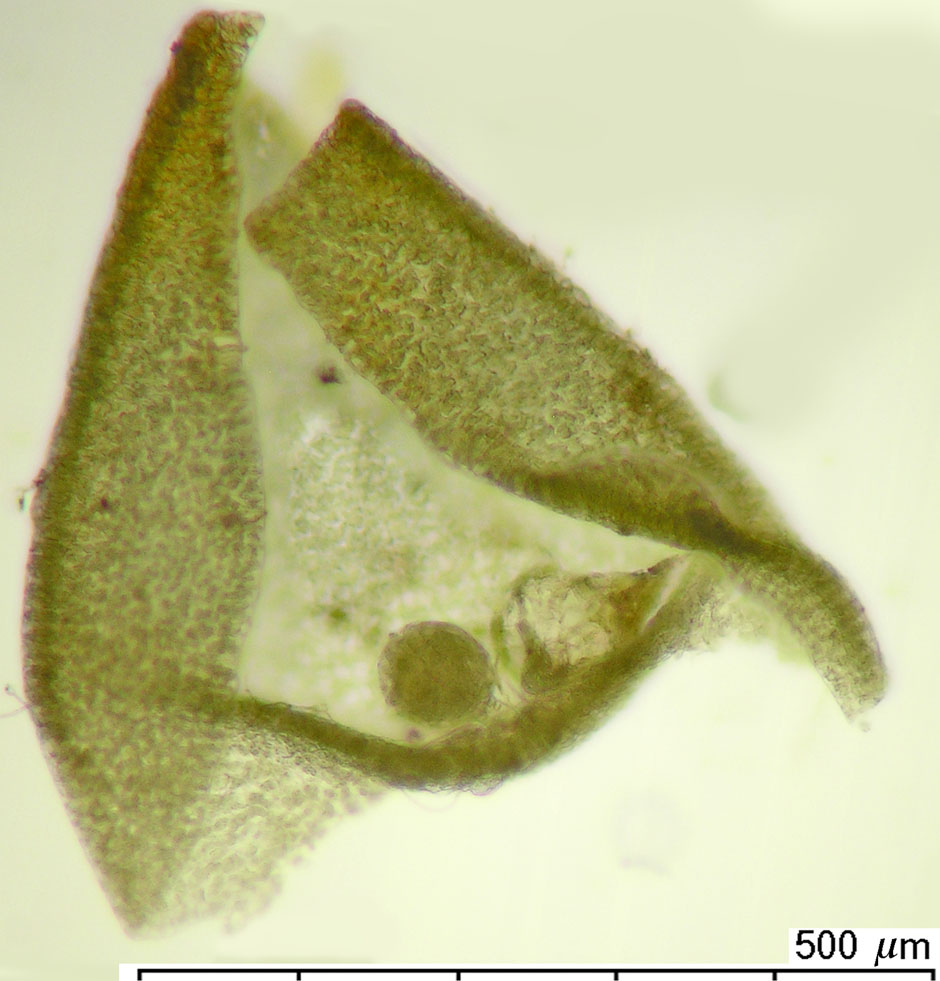 Marsupella brevissima Antheridia in bract from below gynoecium; Mt. Ashland, Jackson Co., Oregon. DHW 2573b.
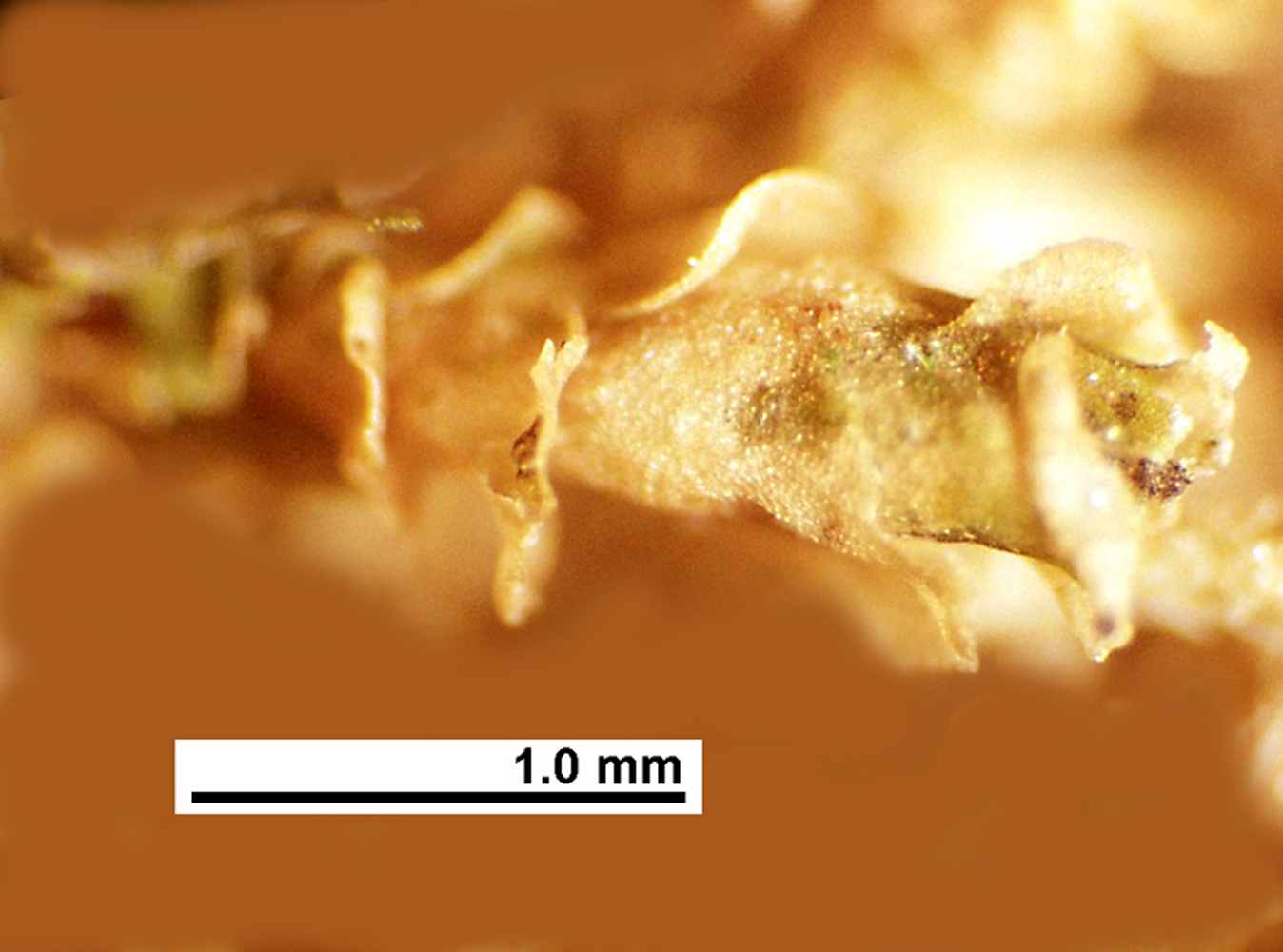
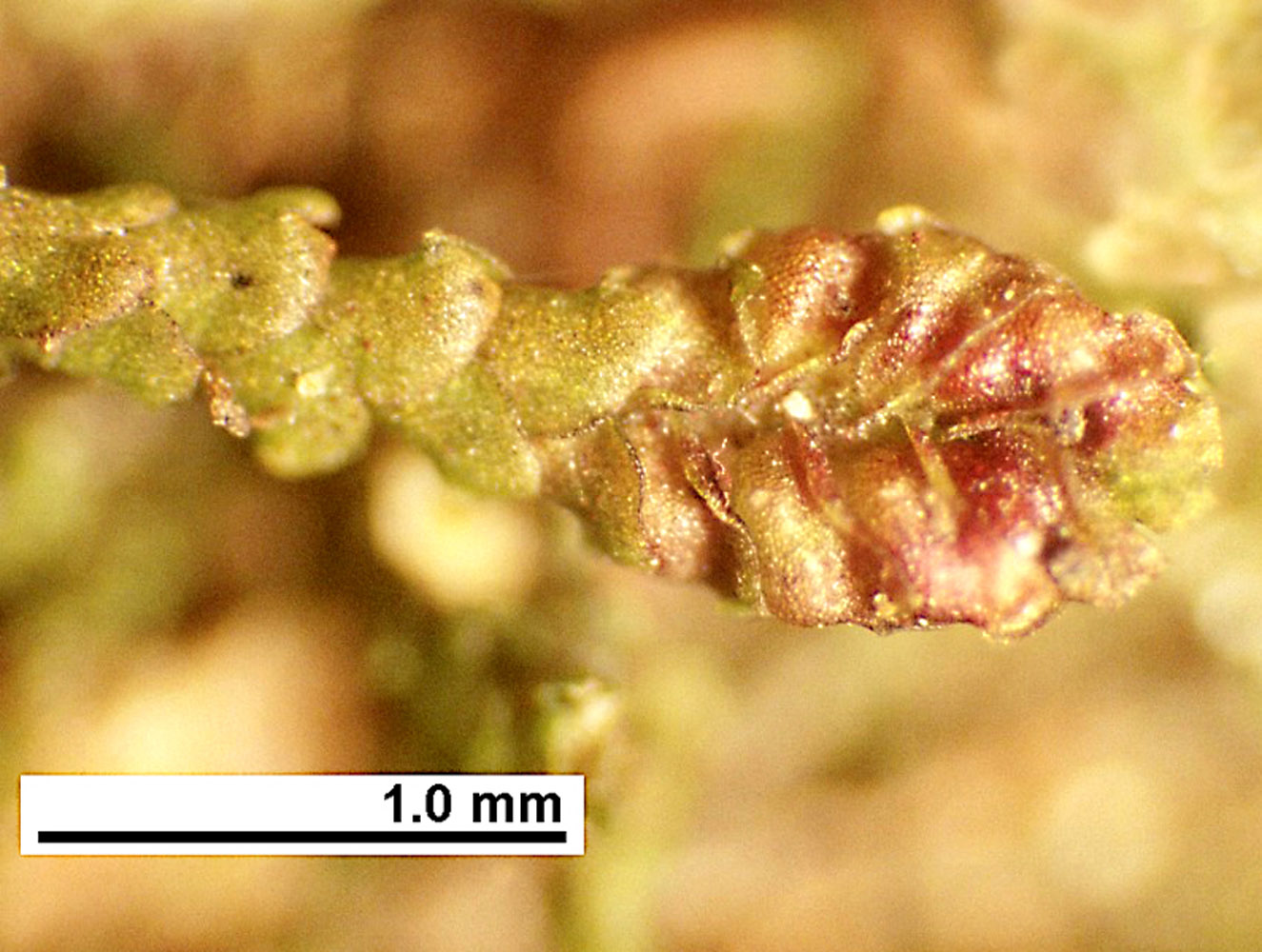 Left - Female shoot; Right - Male shoot; Excelsior Pass Trail, Whatcom Co., Washington. DHW
4766 (?)
Left - Female shoot; Right - Male shoot; Excelsior Pass Trail, Whatcom Co., Washington. DHW
4766 (?)
GO BACK ONE STEP
if less than 0.5 mm wide
GO BACK ONE STEP
if more than 0.5 mm wide